When a loved one with dementia no longer recognizes you, caregiving becomes emotionally and practically challenging. This article explores communication strategies, compassionate phrases, and real conversation examples for family caregivers supporting people with dementia or Alzheimer’s at home in the USA. Learn evidence-informed techniques, safety tips, and scripts to reduce distress, maintain connection, and protect both your loved one and yourself.
Why recognition fails and how it feels for everyone involved
It is perhaps the single most painful moment in the caregiving journey. You walk into the room, smile at your mother or husband, and are met with a blank stare. Or worse, fear. They might ask who you are, or politely ask when their “real” daughter is coming home. This isn’t just forgetfulness. It feels like a fundamental break in your shared reality. Understanding why this happens doesn’t take away the sting, but it does help you manage the situation without falling apart. We need to look at the biology behind the behavior and, just as importantly, how to handle the heavy emotional toll it takes on you.
The biology behind the blank stare
To navigate this, you have to understand that recognition is a complex network, not a single switch in the brain. In Alzheimer’s disease, damage often starts in the hippocampus, which handles episodic memory. This explains why they might forget you visited yesterday. But as the disease progresses, it moves to the temporal neocortex and the fusiform gyrus. These are the areas responsible for processing faces. When these circuits fail, the person literally cannot map your facial features to the concept of “daughter” or “spouse.” It is a condition known as prosopagnosia. They might see eyes, a nose, and a mouth, but the brain fails to assemble them into a familiar identity.
In other forms of dementia, the mechanics differ slightly. Lewy body dementia often involves visual hallucinations or fluctuations in attention, meaning they might recognize you one hour and mistake you for a stranger the next. Vascular dementia can cause stepwise declines, where recognition drops suddenly after a silent stroke or TIA. It is important to note that currently, no medication can fully restore these lost memories or repair the structural damage causing recognition loss; treatments focus on management rather than cure. The lack of recognition is not a choice—it is a physiological failure of the brain’s hardware.
Sudden vs. gradual changes
One of the most critical distinctions you must make is the speed of this change. Dementia is typically a slow burn. The loss of recognition usually happens gradually over months or years. If your loved one knew you on Tuesday but wakes up on Wednesday completely confused and unable to recognize you, that is not typical dementia progression. That is a red flag for delirium. Delirium is an acute, sudden state of confusion that is often reversible. In older adults, this is frequently caused by urinary tract infections (UTIs), dehydration, pneumonia, or medication side effects. According to 2025 clinical data, infections and metabolic disturbances are standard reversible contributors that need immediate medical attention. If the change is rapid, do not assume it is just “the disease getting worse.” You need to investigate.
When to call the doctor
You should contact primary care or neurology if recognition declines persist, but immediate action is needed for rapid shifts. Look for the warning signs. If the lack of recognition is accompanied by a fever, falls, difficulty breathing, or a sudden inability to stay awake, this is a medical emergency. You need to rule out acute causes. Even without emergency symptoms, a sudden drop in cognitive ability warrants a tailored assessment. This includes checking for simple things like hearing and vision loss. If they cannot hear your voice clearly or see your face due to cataracts or lost glasses, their brain has even less data to work with. A medication review is also essential. Drugs like anticholinergics, sedatives, or even some over-the-counter sleep aids can cloud cognition enough to impair recognition.
The emotional fallout for caregivers
We rarely talk enough about what this feels like for you. The clinical term is “ambiguous grief.” You are grieving the loss of a person who is still sitting right in front of you. It is messy and painful. You might feel anger that you are working so hard for someone who treats you like a stranger. You might feel intense guilt for feeling that anger. Some caregivers even admit to feeling a strange sense of relief when the person forgets them, because it means the person is no longer asking to go home to a reality that doesn’t exist. All of these reactions are normal. You are not a bad caregiver for feeling rejected. You are a human being experiencing a profound loss of connection.
This emotional complexity extends to the wider family. Explaining this to children requires simplicity and reassurance. You can explain that “Grandpa’s memory is sick,” emphasizing that it is not the child’s fault and that love remains even when names are lost. For yourself, acknowledging these feelings rather than burying them is vital. Isolation makes it worse, so finding a space to say “this hurts” is part of the job.
Practical steps for documentation
While you are processing the emotions, you also need to put on your detective hat for the doctors. Clinicians rely on your observations to diagnose what is happening. Start a simple log. Write down the date and time the recognition failed. Note exactly what they said. Did they ask “Who are you?” or did they call you by a sibling’s name? Note the context. Did it happen in the late afternoon? This could be sundowning. Did it happen after a medication change? This data helps the doctor differentiate between disease progression and treatable delirium. Bringing a clear, written record to your appointment is more useful than a general description of memory loss.
Moving toward connection
When the brain fails to recognize a face, we have to rely on other channels. The goal shifts from trying to force them to remember facts to trying to connect with feelings. If they don’t know you are their wife, but they know they feel safe with you, that is a win. We have to let go of the need to be “right” about our identity to preserve the connection that remains. This requires a shift in how we speak, how we move, and how we react when the inevitable “Who are you?” comes up. Empathy is your strongest tool here. Imagine how terrifying it must be to be surrounded by people who claim to know you when you have no memory of them. Your reassurance matters more than your name. In the next section, we will look at the specific words and nonverbal techniques that can bridge this gap when memory fails.
Practical communication techniques to reduce distress and preserve dignity
Understanding the neurological reasons why a loved one no longer recognizes you helps process the emotional pain, but it doesn’t solve the immediate problem of how to get through the day. When recognition fails, the goal of communication shifts. We stop trying to pull the person back to our reality and start trying to make them feel safe in theirs. This requires a specific set of tools that prioritize dignity over accuracy.
Choosing the Right Approach: Validation vs. Reality
For years, caregivers were taught “reality orientation”—correcting the person to keep them grounded in the present. If your father asked for his mother (who passed away decades ago), the old advice was to gently remind him she was gone. We now know that for someone in the moderate to late stages of dementia, this is often counterproductive. It forces them to grieve a fresh loss every time and highlights their cognitive failure, leading to shame and distress.
Validation Therapy
This approach is usually more effective when recognition is lost. Instead of correcting facts, you validate the emotion behind the words. If your spouse looks at you with zero recognition and asks where their husband or wife is, they are likely expressing a need for security or love. A validation response acknowledges that feeling. You might say, “You miss him very much, don’t you? He was a wonderful man.” This reduces anxiety because you aren’t arguing with their brain’s reality. You are connecting with their emotional state.
Many caregivers feel guilty about this approach, fearing it is “lying.” However, in dementia care, we prioritize kindness over factual accuracy. If your father believes he needs to go to work, telling him he retired twenty years ago might devastate him. Saying, “The office is closed for the holiday, let’s have coffee,” joins his reality to reduce anxiety. This preserves dignity and keeps him calm.
Gentle Reality Orientation
This still has a place, but mostly in the very early stages or when the person is calm and asking for clarification. If they seem lucid and ask, “Is it Tuesday?”, it is fine to say, “Yes, it’s Tuesday.” However, if they are agitated and insisting it is 1975, correcting them will likely escalate the situation. Read the room. If the truth causes distress, switch to validation.
Reminiscence and Life-Story Cues
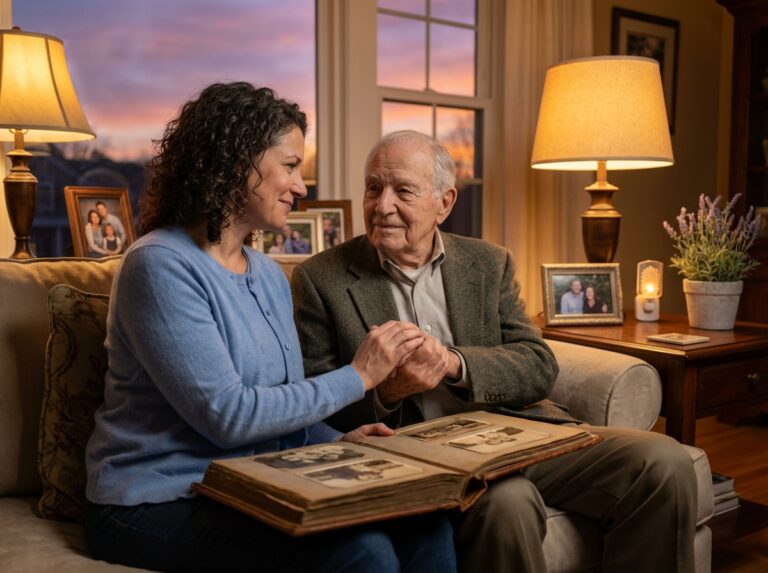
When facial recognition fades, emotional memory often remains. Using cues from their past can bridge the gap. This isn’t just about looking at old photo albums; it is about using sensory triggers. Music from their formative years (typically ages 10–30) is a powerful tool to soothe agitation and trigger positive associations [3]. If they don’t know who you are, playing a favorite song or handing them a familiar object related to their former career or hobby can help them feel safe with you, even if they can’t name you.
Concrete Verbal Tactics
How you speak is just as important as what you say. Processing speed slows down significantly in dementia, and complex language becomes noise. To reduce frustration, strip your communication down to the essentials.
Use Short Sentences and One Idea
Cognitive overload leads to shutdowns. Avoid stringing instructions together. Instead of saying, “Let’s go upstairs, brush your teeth, and get your pajamas on,” break it down. Say, “Let’s go upstairs.” Once you are there, move to the next step. One idea per sentence allows the brain to catch up.
The 10-Second Pause
This is one of the hardest things to do, but it is essential. After you ask a question or give a prompt, wait. Count to ten or even thirty in your head. It takes time for a damaged brain to process sound, interpret meaning, and formulate a response [3]. If you repeat yourself too soon, you reset their processing clock, which leads to frustration for both of you.
Limit Choices
Open-ended questions are overwhelming. Asking “What do you want for lunch?” requires searching a massive mental database. Instead, use forced-choice questions with only two options: “Do you want soup or a sandwich?” [3]. This empowers them to make a decision without the cognitive burden of retrieving words.
Preferred Names and Tone
Use the name they respond to best. In some cases, a parent might stop responding to “Mom” because they believe they are a young girl, not a mother. They might respond better to their first name. Experiment to see what works. Always keep your tone lower in pitch and calm. High-pitched, frantic voices signal danger to the primitive parts of the brain that are still active.
Nonverbal Communication and Environment
When words fail, your body language does the heavy lifting. A person with dementia might not understand your sentence, but they can read your tension. If you are rushing or stressed, they will mirror that agitation.
Proximity and Mirroring
Approach from the front so you don’t startle them. Get on their eye level—standing over someone can feel threatening, especially if they don’t recognize you. Mirror their mood to connect, then gradually shift to a calmer state. If they are pacing, walk with them for a moment before slowing down.
The Power of Touch
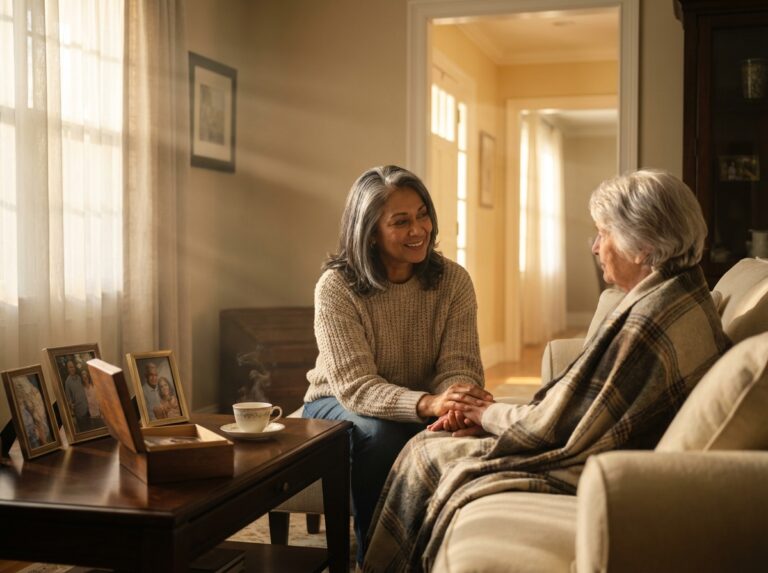
If it is safe and they are not aggressive, gentle touch can communicate safety better than words. A hand on the forearm or shoulder can ground them. However, watch for their reaction. If they pull away, respect that boundary immediately.
Environmental Adjustments
Communication is impossible if the environment is fighting you. Reduce background noise; turn off the TV or radio when talking. Ensure the lighting is bright enough to see your face clearly—shadows can look like threats. Visual aids can also replace verbal nagging. Labeling drawers with words like “Shirts” or using a photo board with family members’ names and relationships can provide constant, passive reassurance [3].
Safety and De-escalation
There will be moments when lack of recognition turns into fear or aggression. If they believe a stranger is in their house, their panic is a rational response to their reality. You cannot force them to trust you in that moment.
Handling Risky Situations
Activities like bathing or toileting are high-risk because they involve vulnerability. If they refuse help because they don’t know you, do not force it. Step back. Give them space. Forcing care on a frightened person can lead to physical injury for both of you. Try again later, perhaps approaching with a different tone or a distraction.
Protecting Against Vulnerability and Wandering
People who do not recognize family members are also highly vulnerable to strangers and wandering risks. Secure the home environment by installing door alarms that chime when opened and enrolling in safety programs like MedicAlert. For phone scams, consider removing the landline or installing a blocker that only allows known numbers. Keep financial documents and credit cards locked away; prevention is far easier than remediation.
Redirection and Distraction
If they are fixated on a distressing idea (like needing to go “home”), don’t argue. Validate the feeling (“You want to go home”), then redirect to a sensory activity. “We can go soon. Let’s have some ice cream first.” Food, music, or a simple task like folding towels are effective bridges to move their attention away from the distress [3].
Documentation
Every person with dementia is different. Keep a simple log or a “one-page care plan” [34]. Note what time of day recognition is worst (often late afternoon, known as sundowning) and which phrases calm them down. Write down what doesn’t work so you don’t repeat mistakes. This individualized plan becomes your playbook for bad days.
These techniques require patience and practice. You won’t get it right every time. The goal isn’t perfection; it’s connection. By adjusting how you speak and act, you can reduce the fear that comes with memory loss and maintain a bond, even when they aren’t sure who you are.
Phrases and conversation examples caregivers can use right away
Knowing the theory behind validation or redirection is one thing. Finding the right words at 2 a.m. when your husband looks at you with total strangers’ eyes is something else entirely. You need scripts. You need go-to phrases that don’t require quick thinking when you are exhausted.
The following scenarios cover the most frequent communication hurdles caregivers face in 2025. These scripts are not magic spells, but they are tested tools designed to lower heart rates—yours and theirs.
When They Are Frightened and Don’t Know You
Fear is often the root cause of aggression or withdrawal. If they don’t recognize you, you are a stranger in their personal space.
The Goal
Establish safety immediately. Do not try to force them to remember your name or relationship.
Nonverbal Cues
Show your open palms. Move slowly. Stand slightly to the side rather than directly in front, which can feel confrontational. Breathe slowly; they will mirror your physical state.
Script Option 1 (Direct Reassurance)
Caregiver: “You look worried. I’m here with you.”
Person: “Who are you? Get out!”
Caregiver: “I’m [Name]. I’m here to help you be safe. I’m not going anywhere.”
Action: Take a step back to give them space.
Script Option 2 (Distraction/Bridge)
Caregiver: “It’s okay. Everything is quiet and safe.”
Person: “I don’t know this place.”
Caregiver: “It feels different today. Let’s sit by the window and look at the garden. The birds are out.”
When They Call You by Another Name
It is common for a spouse to be confused with a parent, or an adult child to be confused with a sibling. This usually means they are looking for the feeling that person gave them—security, love, or authority.
The Goal
Connect with the emotion, not the fact. Correcting them often causes shame or arguments.
Scenario: Calling a Daughter “Sister”
Person: “Sarah (sister’s name), did you bring the mail?”
Caregiver (Daughter): “I didn’t bring the mail yet. Tell me, what are you hoping to get from Sarah?”
Person: “She always writes to me.”
Caregiver: “She writes beautiful letters. I’d love to hear about the last one she sent.”
Scenario: Calling a Spouse “Mom” or “Dad”
Person: “Dad, I want to go home.”
Caregiver (Spouse): “You miss home. I know. I’m right here with you. You are safe with me.”
Note: If playing along feels like lying to you, focus on the “safe” part. You are providing the safety a parent would provide.
When They Accuse You of Stealing or Lying
Paranoia stems from memory gaps. If they cannot remember where they put a wallet, the brain fills the gap with a logical explanation: someone took it.
The Goal
Validate the distress and join their “team” to solve the problem.
Opening Lines
Avoid saying “I didn’t take it.” This pits your reality against theirs.
The Script
Person: “You stole my money! I know you took it!”
Caregiver: “That sounds very upsetting. I would be mad too if my money was gone.”
Person: “Well, give it back!”
Caregiver: “I don’t have it, but I will help you find it. Let’s look in this drawer together to see if we can find it.”
Follow-up: While looking, steer the conversation to a distraction. “Look, here is that old photo of us in Chicago.”
Repetitive Questioning
“What time is it?” or “When are we leaving?” repeated every two minutes indicates high anxiety or a lack of temporal grounding.
The Goal
Provide a solid anchor. Answering the question with facts rarely works for long because the short-term memory loop is broken.
The Script
Person: “When are we going?”
Caregiver: “We are staying here tonight. We are safe.”
Person (2 mins later): “When are we going?”
Caregiver: “We are having dinner at 5:00. Look, I wrote it right here on the board for us.”
Action: Point to a whiteboard or large clock. Visual cues last longer than spoken words.
Refusal to Bathe or Change Clothes
Bathing is vulnerable and cold. If they don’t recognize you, being naked near you is terrifying.
The Goal
Comfort and autonomy. Give them control through limited choices.
The Script
Caregiver: “Would you like a warm towel now, or a quick shower later?”
Person: “No shower.”
Caregiver: “Okay, no shower right now. Let’s just wipe your face with this warm cloth. It feels good.”
Technique: Start small. Once the warm cloth is accepted, you can often proceed to other areas. Narrate every step: “I am going to wash your arm now.”
Mealtime Resistance
They may not recognize the food, the utensils, or the process of eating.
The Goal
Nutrition without stress.
The Script
Caregiver: “Here is some toast.” (Keep it simple. One food at a time).
Person: (Stares at plate)
Caregiver: (Demonstrates taking a bite) “Mmm, it’s warm. Try one bite.”
Troubleshooting: If they refuse, check the environment. Is the plate white on a white table? Use a dark placemat to create high contrast so they can see the food clearly.
Sundowning and Sleep Disruption
Late afternoon confusion often brings a desperate need to “go home” or “get to work.”
The Goal
Reduce stimulation and validate the urge to be somewhere else.
The Script
Person: “I have to get to the bus! I’m late!”
Caregiver: “The bus has already gone. It doesn’t run at night.”
Person: “But I have to go!”
Caregiver: “You are worried about being late. It’s okay. The work is done for today. Let’s sit by the window and listen to this song you love.”
Environment: Close the curtains to hide the dark outside. Turn on bright indoor lights to reduce shadows.
Moments of Loneliness or Sadness
Sometimes the lack of recognition comes with a deep sense of loss. They may cry for people who have passed away.
The Goal
Connection and comfort.
The Script
Person: “I want my mother.”
Caregiver: “You miss your mother. She was a wonderful woman.”
Person: (Crying)
Caregiver: “I’m here. Tell me about her baking. Did she make that lemon cake you like?”
Action: Gentle touch on the hand or shoulder if they accept it. Sit at their level.
Troubleshooting When Scripts Fail
Even the best phrases don’t work every time. If you try a script and the agitation increases, stop immediately.
The 10-Second Rule
After you ask a question or say a phrase, wait at least 10 to 30 seconds. Their processing speed is slower. If you repeat yourself too quickly, it sounds like shouting to them.
Step Back and Reset
If you are met with anger, say, “I’m sorry I upset you. I will come back in a minute.” Leave the room if it is safe to do so. This allows both of you to reset emotionally. When you return, start fresh as if the previous interaction didn’t happen.
Tailor to Their Story
Use their history. If they were a teacher, ask for their “help” grading papers (stacking mail). If they were a mechanic, ask them to check a tool. Using language from their past career or cultural background validates their identity even when they lose their present reality.
When to Seek Professional Advice
If these strategies consistently fail and the person becomes aggressive, self-harming, or terrified to the point of not eating or sleeping, it is time to consult a doctor. Sudden changes in recognition or behavior can also signal a medical issue like a urinary tract infection, not just dementia progression.
Final takeaways action plan and next steps for caregivers
Reading through strategies and explanations is one thing, but applying them when you are tired and heartbroken is another. You now understand why recognition shifts happen and have a toolkit of phrases to use, yet the daily reality of dementia care requires a structured approach to keep everything manageable. This final section takes the concepts we have discussed and organizes them into a prioritized action plan. This isn’t just about managing symptoms; it is about stabilizing your environment and protecting your own well-being for the long haul.
Immediate Medical and Safety Priorities
Before you adjust your communication style, you must ensure that the lack of recognition isn’t stemming from an acute medical issue. Sudden changes in mental status are not always the natural progression of dementia.
Rule Out Acute Causes First
If recognition drops significantly over just a few hours or days, do not assume it is just “the dementia getting worse.” In 2025, clinical guidance emphasizes distinguishing gradual decline from delirium. If you see rapid changes accompanied by fever, falls, or lethargy, contact your primary care provider immediately. A simple urinalysis or medication review could reverse the sudden drop in cognition.
Document the Patterns
Clinicians rely on data to help you. Instead of saying “she’s worse,” keep a simple log for one week. Note the time of day when recognition fails—is it during “sundowning” hours in the late afternoon? Does it happen after specific medications? Write down the exact words used. This documentation helps neurologists determine if the issue is strictly cognitive or if there are behavioral triggers we can modify.
Create Your Communication “Cheat Sheet”
Consistency is the best way to reduce anxiety for someone with memory loss. You cannot be the only one who knows how to soothe them. You need to externalize your knowledge into a simple, one-page communication plan. This is especially vital if you have respite workers or other family members stepping in to help.
Draft a One-Page Guide
Type up a single sheet that can be taped to the refrigerator or kept in the care binder. It should include the person’s preferred name (sometimes a nickname works better than a formal name), three specific phrases that calm them down, and a list of “do not use” words that trigger agitation. Include a brief script for introductions, such as “I am [Name], your [Relation]. I am here to help with [Activity].”
Prepare Your Go-To Scripts
Mental fatigue makes it hard to improvise in the moment. Memorize two or three validation scripts so they become automatic. When they don’t recognize you, have a reflex phrase ready like, “I’m here, you’re safe. Let’s have some tea.” By having these scripts ready, you reduce your own panic response, which in turn helps keep your loved one calm.
Environmental Adjustments for Recognition
Your home environment can either support memory or confuse it. Small changes to the physical space can act as external memory aids, reducing the cognitive load on your loved one.
Optimize Visual Cues
Place a few labeled photos at eye level in the rooms they use most. A photo of you with your name and relationship printed in large, high-contrast text can serve as a passive reminder. However, avoid clutter. Too many photos can be overstimulating. Stick to 6–8 clear images. If they struggle to find rooms, place a photo of a toilet on the bathroom door or a bed on the bedroom door. These visual anchors help maintain independence and reduce the anxiety of feeling lost in one’s own home.
Safety-Proofing for Wandering
When recognition fades, the risk of wandering increases because the person may feel they are in a stranger’s house. Ensure you have door alarms or sensors installed. In 2025, technology has made this easier with discreet home monitoring systems. Register your loved one with a safe return program, such as the MedicAlert + Alzheimer’s Association Safe Return, so that if they do leave the house, first responders have their information immediately.
Legal and Practical Logistics
While we focus heavily on the emotional side of care, the administrative side cannot be ignored. When recognition begins to fail, it is a signal to ensure all legal and medical logistics are locked down.
- Review Legal Documents: Ensure your Power of Attorney (POA) and Advance Directives are up to date and accessible. If you haven’t done this yet, do it now while the person may still have moments of clarity or before the decline progresses further.
- Emergency Preparedness: Pack a “go-bag” for the hospital. It should contain a copy of the POA, a current medication list, a list of allergies, and a brief summary of their baseline cognitive status. This prevents emergency room staff from assuming their dementia baseline is actually acute delirium, or vice versa.
Caregiver Sustainability and Support
You cannot maintain this level of compassionate communication if you are running on fumes. The emotional toll of not being recognized is profound, often leading to what is called “ambiguous loss”—grieving someone who is still physically present.
Schedule Respite Care
Burnout is a medical reality, not a character flaw. Look into the GUIDE (Guiding an Improved Dementia Experience) Model programs or local adult day centers. Even a few hours a week allows you to decompress. You need time where you do not have to be the “memory keeper” for someone else.
Seek Emotional Support
Join a support group where you can say, “My mother didn’t know who I was today,” and everyone in the room understands the pain without you having to explain it. The Alzheimer’s Association and local community centers offer these groups. The total lifetime cost of care for someone with dementia is estimated at more than $405,000, and the emotional cost is even higher. Validating your own grief is just as important as validating your loved one’s reality.
Moving Forward with Compassion
If you take nothing else from this article, remember this: when they don’t recognize you, it is not a rejection of your love. It is a symptom of a disease that is attacking their brain’s ability to access the file where you are stored. Your history together is still there, woven into their identity, even if they cannot pull the thread to find it right now.
By using the scripts we’ve practiced, ruling out medical triggers, and setting up a supportive environment, you are doing incredible work. You are preserving their dignity and maintaining a connection, even if that connection looks different than it used to. Small adjustments in how you speak and how you set up the room can lower distress and bring moments of peace to both of you.
Alzheimer’s Disease Facts and Figures show us that millions of families are walking this same path. You are not alone in this. Reach out for help, use the tools you have learned, and take it one interaction at a time.
Suggested Next Steps for Deep Dives:
For more specific assistance, look for resources on visual memory aids and home labeling, detailed dementia safety checklists for fall prevention, and local caregiver respite and support resources to help you build your sustainability plan.
Sources
- Alzheimer's Disease Facts and Figures — In 2025, health and long-term care costs for people living with Alzheimer's and other dementias are projected to reach $384 billion — not including the value of …
- The Cost of Dementia in 2025 – April 23, 2025 – USC Schaeffer — In 2025, there are 5.6 million people living with dementia in the United States, with 5.0 million ages 65 and older. Dementia refers to a group …
- [PDF] Executive Summary | 2025 Alzheimer's Disease Facts and Figures — The total lifetime cost of care for someone with dementia is estimated at more than $400,000. ($405,262) with 70% of these costs borne by family caregivers in …
- New Study Finds Fewer Americans Are Developing Dementia—But … — At the same time, prevalence rose from 10.5% to 11.8%, with nearly 2.9 million beneficiaries—about 12% of traditional Medicare enrollees—living …
- Risk and future burden of dementia in the United States – NIH — They projected that the number of new dementia cases in the U.S. will double over the next four decades, from about 514,000 in 2020 to about 1 …
- More than 7 million Americans living with Alzheimer's | AHA News — Dementia cases in the U.S. are expected to double by 2060, reaching 1 million new cases per year, according to a study released Jan. 13 by NYU …
- 2025 Alzheimer's disease facts and figures — An estimated 7.2 million Americans age 65 and older live with Alzheimer's dementia today. This number could grow to 13.8 million by 2060.
- GUIDE (Guiding an Improved Dementia Experience) Model – CMS — More than 6 million Americans live with dementia with 14 million projected cases by 2060. Despite the disease affecting millions of Americans, …
- Dementia statistics in the United States 2025 – Global One Home Care — 19 billion hours, $413 billion value – In 2024, unpaid dementia caregivers provided an estimated 19 billion hours of care, equivalent to over $413 billion in …
Legal Disclaimers & Brand Notices
The information provided in this article is for informational purposes only and does not constitute professional medical advice, diagnosis, or treatment. Always seek the advice of a physician or other qualified health provider with any questions you may have regarding a medical condition, including the management of dementia, Alzheimer’s disease, or acute delirium. Never disregard professional medical advice or delay in seeking it because of something you have read in this content.
All product names, logos, and brands mentioned in this article are the property of their respective owners. All company, product, and service names used in this text are for identification purposes only. Use of these names, logos, and brands does not imply endorsement or affiliation.